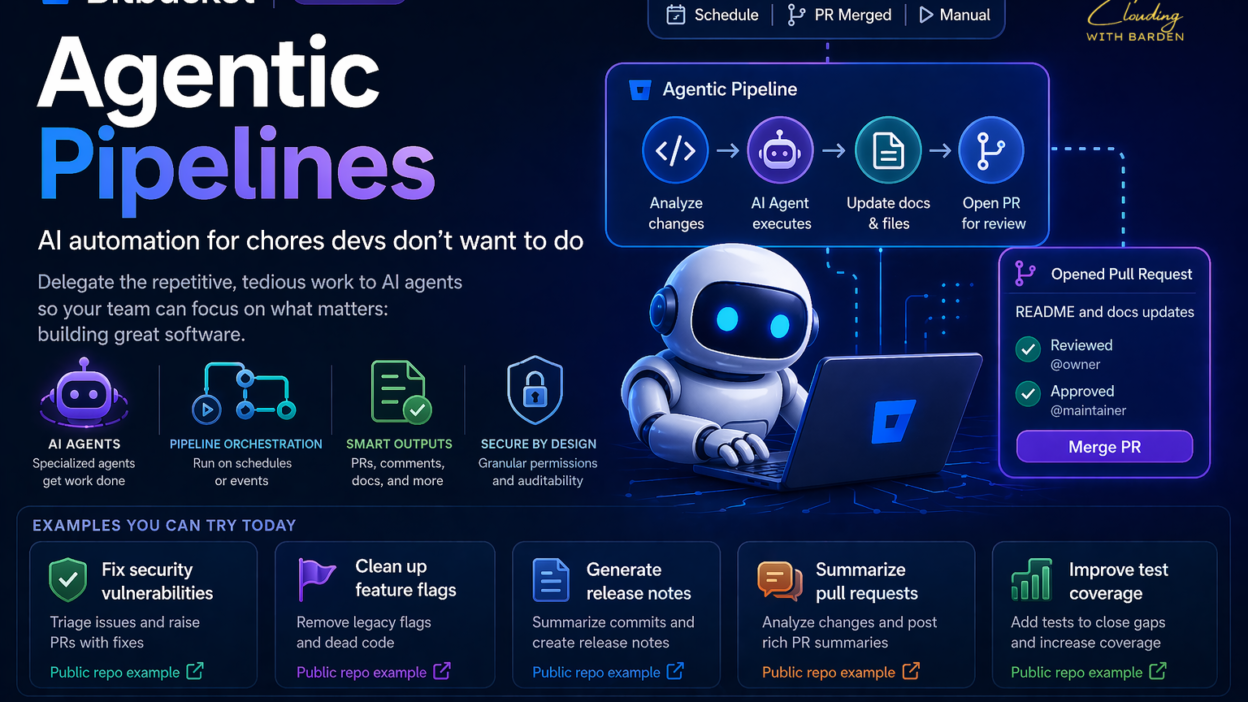
Bitbucket Pipelines is expanding beyond traditional CI/CD with the introduction of Agentic Pipelines, now available in open beta.
This update introduces a new way to automate the kind of work that typically sits outside the standard build-test-deploy cycle—tasks that are necessary, but often repetitive, manual, and easy to defer.
The problem: work that never gets prioritized
A large portion of development time isn’t spent building features.
It’s spent on:
- updating documentation
- cleaning up technical debt
- troubleshooting pipeline failures
- maintaining consistency across repositories
These tasks matter, but they’re often:
- repetitive
- time-consuming
- deprioritized in favor of feature work
Over time, they accumulate into technical debt.
What Agentic Pipelines introduces
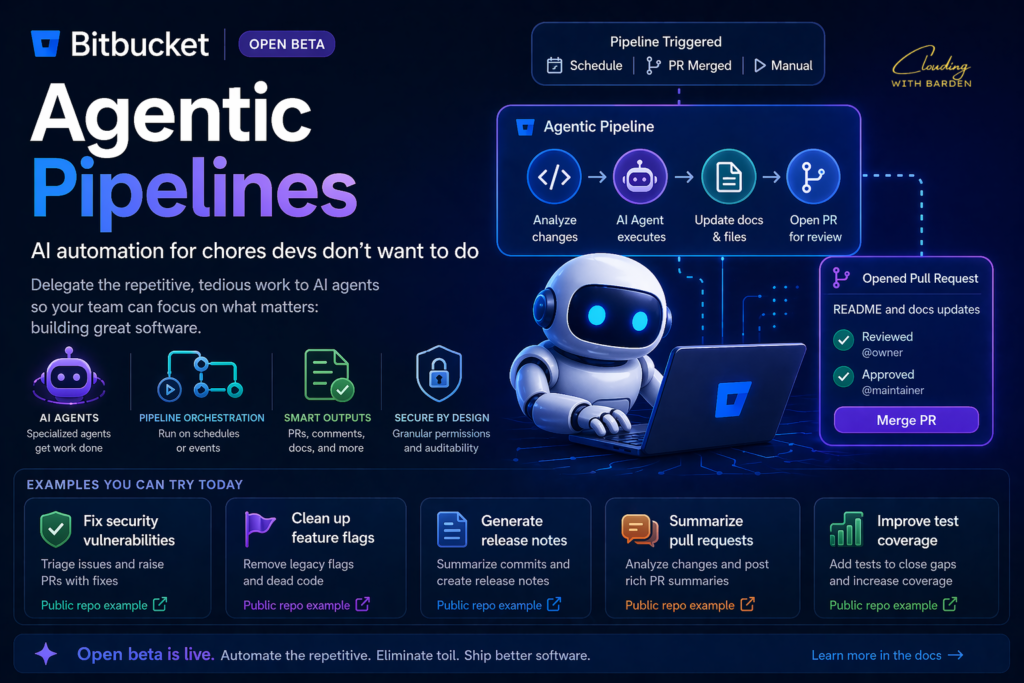
Agentic Pipelines extends the idea of pipelines from running scripts to orchestrating AI agents.
Instead of writing scripts to handle every scenario, you define an agent within your pipeline configuration and give it:
- a task
- a set of constraints
- a trigger (event-based or scheduled)
The agent then runs as part of the pipeline and produces results such as pull requests, comments, or updates to files.
A practical example: keeping documentation in sync
One of the simplest use cases is maintaining repository documentation.
Instead of manually updating a README, an agent can:
- analyze code changes between branches
- identify outdated or missing documentation
- update relevant sections
- create a new branch
- open a pull request with a summary of changes
- assign reviewers
If no updates are needed, it still documents what it checked and why no changes were made.
This removes the need for:
- manual updates
- “docs duty” rotations
- ad-hoc scripting
How it works in practice
Agentic Pipelines are defined directly in your bitbucket-pipelines.yml.
You specify:
- the agent definition (prompt + instructions)
- required permissions (repository and PR scopes)
- when it should run (PR events, merges, schedules)
From there, the pipeline executes the agent as part of its normal workflow.
Use cases beyond documentation
Atlassian highlights several practical use cases already possible:
Security remediation
Agents can analyze vulnerability reports (e.g. from Snyk), triage issues, and raise pull requests with suggested fixes.
Feature flag cleanup
Agents can identify and remove outdated feature flags, update tests, and ensure the codebase reflects current production behavior.
Release notes generation
Agents can analyze commits between versions, categorize changes, and generate structured release notes automatically.
Pull request summaries
Agents can review changes in a PR, categorize them, assess impact, detect breaking changes, and post a detailed summary.
Test coverage improvement
Agents can identify areas with low or missing test coverage and generate additional tests to improve overall quality.
Why not just use scripts?
Many of these tasks are difficult to handle with traditional scripting.
For example:
- understanding code changes
- updating documentation contextually
- summarizing intent behind changes
Scripts tend to be:
- brittle
- hard to maintain
- limited in handling nuance
Agent-based automation provides more flexibility for these types of problems.
Requirements
To use Agentic Pipelines:
- you need a Bitbucket Cloud repository
- you need access to Atlassian’s Rovo Dev (developer AI agent)
Support for third-party tools like Claude Code is expected soon.
What’s next
Atlassian is continuing to expand this model with plans for:
- improved pipeline troubleshooting (including identifying flaky tests)
- automated detection of irrelevant or outdated code
- cross-repository impact analysis
Final thoughts
Agentic Pipelines is not a replacement for CI/CD—it builds on it.
The key shift is in what pipelines are responsible for.
Instead of focusing only on build and deployment, pipelines can now handle ongoing maintenance tasks that are typically manual and inconsistent.
If this model matures, it changes how teams think about automation—not just as execution, but as delegation.
Stay Clouding!